Season of Opulence
For the Menagerie, we gave ourselves a challenge: Make a repeatable raid-like activity that can be completed by six randomly matchmade Guardians who aren’t communicating. We started by listing every memorable mechanic and encounter from both Destiny 1 and 2. We then brainstormed activities that would capture the essence of those mechanics while stripping the communication requirement.
What I worked on:
Design owner for The Hunted and The Riposte encounters
Worked with art to design the space and layout for the encounters
Designed and scripted the encounter mechanic and combatant layouts
Took over ownership of the traversal section of the raid and brought it to shippable

Supporting Bungie’s epic looter shooter
When Bungie teamed up with Activision to release Destiny 2, they knew they needed more help to satiate content hungry players. That’s where VV came in. We created the Warmind expansion for Year 1, Black Armory and Season of Opulence for Year 2, and brought Destiny 2 to PC.
-
Overview:
In this encounter, players need to stand on charge plates at different locations in the arena to activate them. Standing on a charge plate spawns floods of adds, and activating a charge plate spawns a powerful, but slow, enemy that can one-shot weaker Guardians. The party gains points depending on the number of plates charged and bosses killed within the time limit.
Design Process:
Initial Design: Inspired by the Unyielding Terror encounter in the Forsaken expansion, the encounter had players scrambling to avoid an invisble, slow-moving Hive Knight who could one-shot players. Players needed to kill certain enemies near the Knight to make it vulnerable. There were certain issues with this design: it was difficult to convey what players needed to do to make it vulnerable, six players could easily kite it around the space, and it didn’t fulfill the fantasy of being hunted by an overwhelming force.
Iteration Process:
Iteration #1: we moved the encounter’s location down into the Crypts. The narrow, maze-like hallways and extremely low ceiling added a claustrophobic feeling.
We also added the charge plates that required players to stand on them for 5-10 seconds to fully charge. When players started to charge a plate, it would spawn a Treasured Knight to chase them off. While they weren’t invulnerable or as strong as the original enemy, they had a very large health pool and their powerful melee attack could wipe a fireteam if they weren’t careful. Players gained points for successfully charging plates and killing Treasured Knights.
This felt better than the original design but was also kind of static. Fireteams fell into a repetitive rhythm of stepping on a plate, unleashing all their high damage attacks at the Knight until it died and the plate was charged, and moving on to the next.
Iteration #2: We switched up the order. Stepping on a plate now spawned waves of adds to push players off the plate. Fully charging the plate spawned the Treasured Knight. This meant players had to juggle their ammo and power use more. We also made it so two plates in different locations were chargeable at once giving fireteams the riskier option to split up to clear the encounter faster but risk being overrun.
This version felt much better but lacked a solid crescendo.
Final Iteration: We made many small tweaks to the layout, encounter composition, and Treasured Knight tuning. We also added a capstone boss at the end that used an explosive ranged weapon to provide on final challenge and a satisfying conclusion.
-
Overview:
This encounter takes place in a medium sized arena with a hole in the middle. Waves of enemies spawn from different sides alongside sword-wielding Hive Knights. After killing a certain number of enemies, a special miniboss protected by an immunity shield spawns. Players need to kill the Hive Knights, take their swords, and use them to strip the miniboss’ s shields before killing them. The encounter ends when they’ve killed all the minibosses or when the timer expires.
It was inspired by the well received campaign missions where players gains temporary access to Hive swords.
Iteration:
While the core of the encounter never changed, we tried a lot of different variations. The earliest versions required players to only use swords. Destiny places a strong emphasis on personal playstyle via class and weapon loadouts, and we felt that completely removing that, even for just five minutes, was wrong.
We tried the opposite direction where the swords were completely optional (but granted faster progression if used), but this too felt wrong. In the end, we settled on the shield idea as it required at least some engagement with the sword mechanic. Players who liked the sword could continue using it to kill trash mobs while those who didn’t could focus on their main weapons.
-
Destiny raids typically have a section dedicated to traversal. In this one, players need to traverse a large room of floating platforms. Each platform is part of a group. Stepping on any platform in the group starts a hidden timer that collapses all platforms in the group when it expires. Once any player makes it to a checkpoint platform, it raises and locks all platforms in the previous section.
The framework was already in place when I took over this encounter. My job was to tune the layout, timing, and presentation and fix bugs in the scripting. It was a lot of nudging platform placements and adjusting group timers and then testing with every jump type across the three guardian classes.

Black Armory
Black Armory was our first foray into repeatable, seasonal content that would work with random matchmaking. The activity centers around Lost Forges - a wave type encounter where the fireteam must fend off continuous spawns while powering up the forge. In each of the three waves, special enemies spawn with a blue aura. Defeating them drops a battery that needs to be picked up and thrown at the forge before the battery self destructs. Once the forge reaches charge, there’s a short pause before the next wave starts. A boss spawns after the forge is fully charged, and killing it clears the activity.
What I worked on:
I was the design owner for Volundr Forge in EDZ. This involved working with art to ensure the space was the correct size and had a good flow and designing cover layout. The largest part of the work was determining the combatant mix for each wave, where they would spawn, and how they would move around the space.
Bungie’s tool uses volumes, called firing areas, to determine where combatants can go. Designers load each firing area up with a prioritized list of filters such as squad group name, min/max number of combatants, and combatant type. Each combatant type has preferred conditions that they use to determine when they should change position. For instance, a sniper will want a certain minimum distance between itself and any player. If a player advances into that min range, they will first search for a point in their existing firing area that’s valid. If no point is available, that firing area becomes invalid, and they will begin searching for a new firing area that is within their preferred combat range and that they pass the filter check for.
It’s a powerful system that allows designers to create advance/retreat behaviors, flanking, and ambush behaviors as well as control the direction of combat in a space.
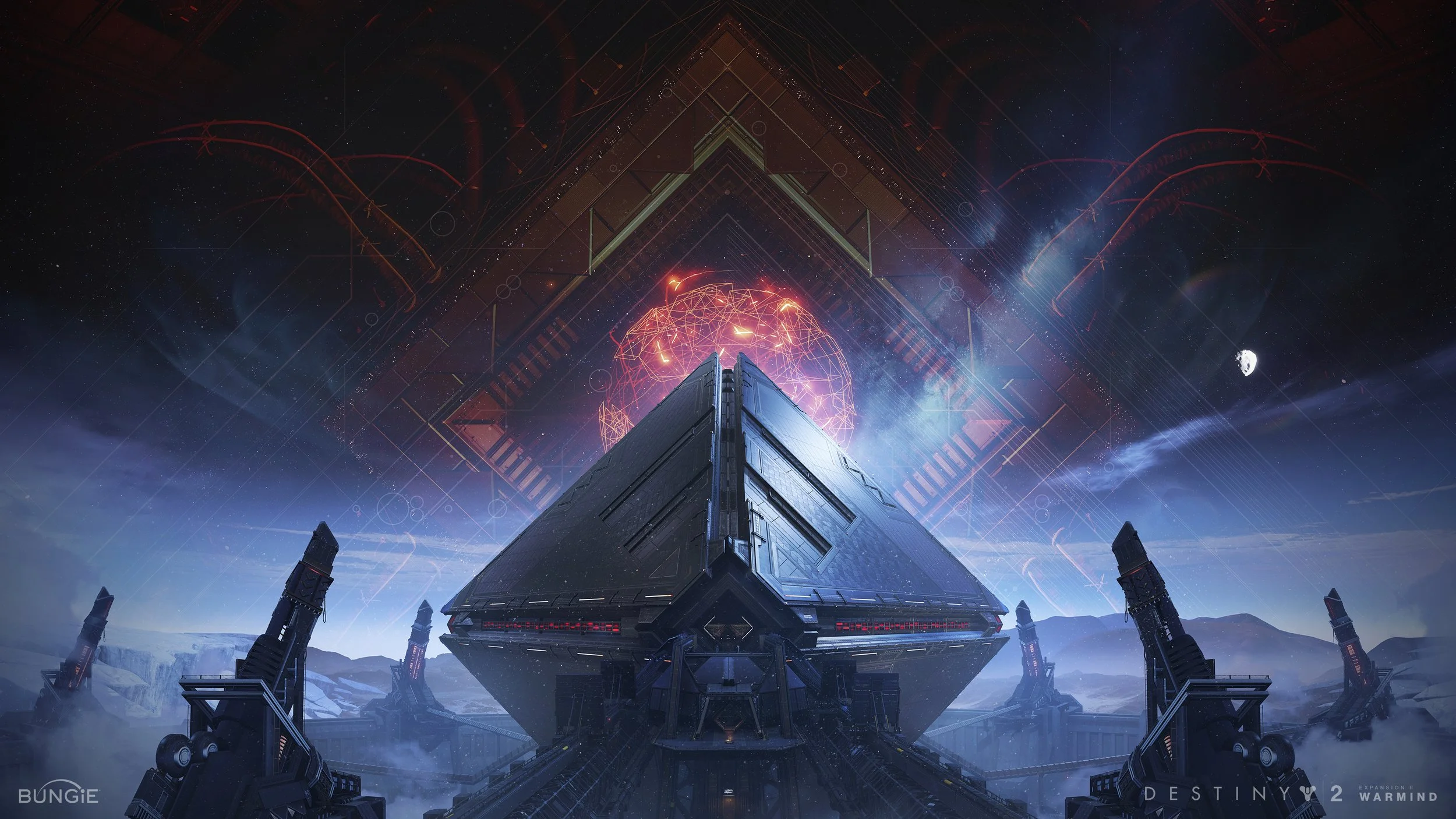
Warmind was a more traditional DLC where we created an entirely new destination and populated it with story missions, adventures, events, and lost sectors.
What I worked on:
Design owner for the second story mission, Pilgrimage
Designed and scripted all combat encounters including the final encounter that introduced our DLC’s new verb, the Javelin
Worked with cinematic team to integrate story sequences
Worked with art to determine layout of the spaces for combat encounters and story reveals
